NSFAS N+2 Rule Explained (2026 Update)


If you rely on NSFAS to fund your studies, you’ve probably heard other students whisper about “the N+2 rule” usually right before exam results come out. It can sound like a technicality until it’s the reason your funding stops.
Here’s the good news: once you understand how the N+2 rule actually works, it stops being scary. It becomes something you can plan around. As an adviser who has walked many students through funding questions, I want to break this down for you in plain language no jargon, no guesswork so you know exactly where you stand and what to do next.
What Is the NSFAS N+2 Rule?
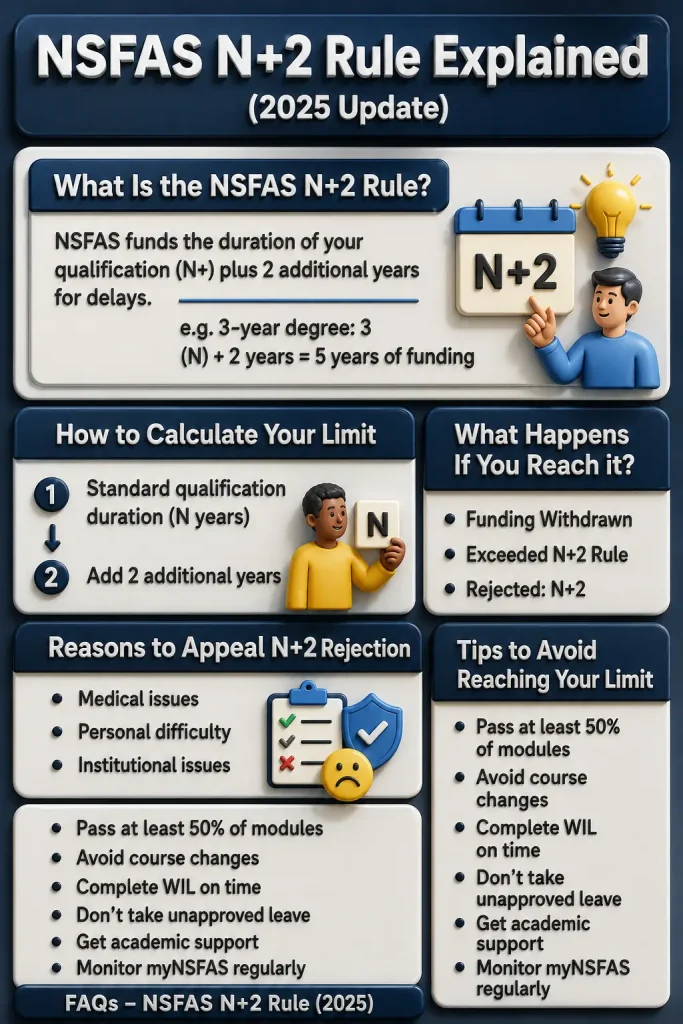
The N+2 rule sets a limit on how many years NSFAS will fund your studies. It’s not designed to trip you up it’s designed to keep the funding system fair and sustainable for every student who needs it.
Here’s how it breaks down:
- “N” = the minimum number of years it officially takes to complete your qualification.
- “+2” = two additional funded years, built in to cover academic setbacks, repeated modules, or personal circumstances.
So in simple terms:
- A 3-year degree (N=3) is funded for a maximum of 5 years.
- A 4-year degree (N=4) is funded for a maximum of 6 years.
Those two extra years exist because NSFAS knows life doesn’t always go according to plan. They’re a safety net but they’re not unlimited.
How the “N” Is Actually Calculated?
This is the part most students get wrong. Your “N” isn’t based only on the years NSFAS paid for — it’s based on the total number of years you’ve been registered at any public higher education institution, whether or not NSFAS funded you during that time.
That means:
- Years you paid for yourself still count.
- Years at a previous institution still count.
- Years spent on a different qualification still count.
Because the calculation depends on your specific first year of registration and institution, the most accurate figures for your situation will always come from the official NSFAS website or your institution’s financial aid office.
Read Also: Can NSFAS Fund You Twice?
Why NSFAS Applies the N+2 Rule?
It can feel like an obstacle, but the rule exists for good reasons. NSFAS uses it to:
- Keep funding fair and available for all students, not just those already in the system
- Prevent funding from being used indefinitely by a small number of students
- Encourage students to stay on track and complete their qualifications
- Manage a limited national budget responsibly
In short: it’s not a punishment. It’s a system designed to stretch limited funding across as many deserving students as possible.
How the N+2 Rule Works: Real Examples
Example 1: A 3-Year Degree
Your qualification normally takes 3 years. Under N+2, NSFAS can fund you for up to 5 years total giving you two extra years to recover from failed modules, illness, or other setbacks.
Example 2: A 4-Year Degree
A 4-year qualification (like many B.Ed or engineering degrees) qualifies for funding up to 6 years total.
Example 3: Changing Courses
If you switch from one qualification to another, your “N+2 clock” does not reset. Every year you were registered and funded still counts toward your total, even in your new course.
Example 4: Moving from TVET to University
The same logic applies here. NSFAS adds together all your previously funded years, regardless of the institution or qualification type, and applies that total against your new N+2 limit.
The takeaway: always know your full study history. It’s the single biggest factor in protecting your funding.
Who Is Affected by the N+2 Rule?
The N+2 rule applies to anyone who has ever received NSFAS funding, including:
- Current university students
- TVET college students (NCV and NATED programmes)
- Students returning after a break in their studies
- Students who changed qualifications along the way
- Anyone funded by NSFAS at any point in the past
If NSFAS has ever paid for your studies, this rule counts you in.
Does the N+2 Rule Affect SASSA Beneficiaries?
No, being a SASSA grant beneficiary does not extend your funding years. The SASSA grant can help you qualify for NSFAS in the first place, but it doesn’t add extra time on top of the standard N+2 allowance. You’re funded on exactly the same terms as any other NSFAS student.
Exceptions and Possible Exemptions
The rule is applied consistently, but NSFAS does allow for exceptions when a student can show genuine, documented hardship, such as:
- A serious or long-term illness
- A registered disability
- A family tragedy or significant emotional distress
- Academic disruption outside your control (e.g., a course cancellation)
- An error made by your institution, not by you
Every case like this is reviewed individually, and strong supporting documentation is essential think medical certificates, official letters, or institutional confirmation.
What Happens When You Exceed the N+2 Limit?
If you go over your N+2 limit, NSFAS will typically:
- Stop paying your tuition and fees
- Stop your monthly allowances
- Change your funding status to something like “Exceeded N+2” on the myNSFAS portal
- Notify your institution directly
This can be a difficult moment, especially if you’re close to finishing your qualification. Many students are caught off guard simply because they didn’t realise how the years were being counted.
How to Check If You’re Close to Your N+2 Limit?
Don’t wait for a rejection letter to find out. Check your status proactively by:
- Logging into your myNSFAS account and reviewing your funding history
- Speaking to your institution’s financial aid office
- Reviewing your own academic record for total years registered
- Manually counting how many years you’ve received NSFAS support so far
Knowing where you stand early gives you time to act, rather than reacting after the damage is done.
How to Stay Within the N+2 Rule?
A few consistent habits go a long way toward protecting your funding:
- Pass at least half of your registered modules each year
- Deal with failed modules as soon as possible, rather than letting them pile up
- Avoid switching qualifications unless it’s truly necessary
- Ask for tutoring or academic support the moment you start struggling
- Choose a realistic module workload each year
- Keep a personal record of how many years you’ve been funded
One difficult year or a single failed module is unlikely to end your funding. It’s the accumulation of multiple setbacks over several years that puts students at risk.
Can You Appeal the NSFAS N+2 Rule?
Yes, appeals are possible but they’re only considered under specific circumstances, generally involving:
- Documented medical problems
- Personal or family hardship
- Academic disruption that wasn’t your fault
- Clear proof that you’re still able to complete your qualification
To submit an appeal:
- Log in to your myNSFAS account
- Navigate to “Track Funding Progress“
- Select “Submit Appeal“
- Choose “Exceeded N+2 Rule” as your reason
- Upload supporting documentation (medical or legal, as relevant)
- Include a short motivation letter explaining your situation
Appeals are usually reviewed individually, and your institution may also need to provide a supporting letter. It’s worth acting quickly appeal windows are typically time-limited, so don’t delay once you receive a rejection notice.
Read also: NSFAS Appeal Online
N+2 Rule for Returning and Continuing Students?
If you’re returning to your studies after a break, or you’ve been funded continuously for several years, NSFAS reviews your entire study history, including:
- Institutions you’ve previously attended
- Any modules you failed or repeated
- Years you took off from studying
- Whether you changed your qualification at any point
This full picture is what determines how many funded years you have left so it pays to keep your own records rather than relying on memory.
Comparison: Funding Limits by Qualification Type
| Qualification Type | Standard Duration (N) | Max NSFAS Funding (N+2) |
|---|---|---|
| TVET Certificate | 1 year | 3 years |
| Diploma | 3 years | 5 years |
| Degree | 3 years | 5 years |
| BTech / B.Ed Honours | 4 years | 6 years |
(Exact durations can vary by programme, so confirm your specific qualification length with your institution.)
Frequently Asked Questions
Conclusion
The N+2 rule isn’t meant to work against you it’s a structure designed to keep NSFAS funding available and fair for as many students as possible. Understanding it early means you can plan your academic path with confidence instead of being caught by surprise later.
Here’s what to remember:
- Your “N” is based on total years registered, not just years funded
- You get two extra years beyond your qualification’s standard duration
- Changing courses or institutions does not reset your funding clock
- Appeals are possible with strong supporting documentation
- Checking your myNSFAS status regularly is the best way to stay ahead
If you’re unsure exactly where you stand, don’t guess log into your myNSFAS portal today, review your funding history, and speak to your institution’s financial aid office for guidance specific to your situation. Acting early is always your best strategy for staying funded and finishing what you started.