Does NSFAS Fund Bridging Courses?

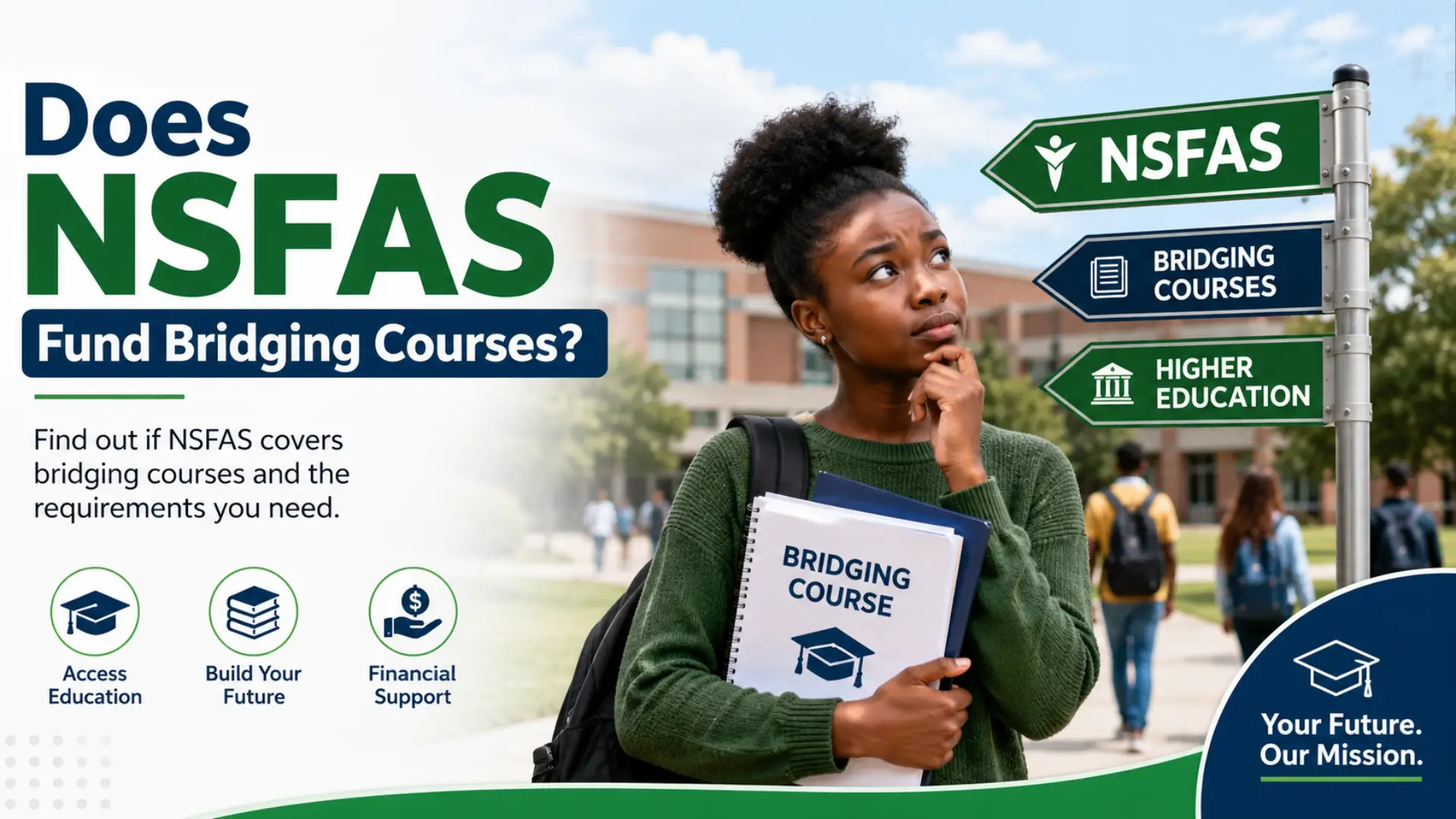
If you’ve applied to a university or TVET college and been told you first need a bridging course to qualify for your dream diploma or degree, your next question is probably about money. Can NSFAS help pay for it? This guide breaks down exactly what NSFAS covers, why bridging courses usually fall outside that scope, and where you can turn for funding instead.
Does NSFAS Fund Bridging Courses?
No, NSFAS does not provide financial assistance for bridging courses at any institution. The scheme only funds a student’s first degree or diploma lasting three years or more at a public university or TVET college. A bridging course is treated as a short course meant to help you qualify for a higher qualification, and NSFAS does not cover it for that reason.
This means the general rule stands across the board: whether you’re looking at a university access programme, a TVET bridging module, or a private college’s bridging offering, NSFAS won’t foot the bill directly.
What Is a Bridging Course?
A bridging course (sometimes called an access course, foundation course, or gateway programme) is a short, non-degree programme designed to help students who narrowly missed the entry requirements for a diploma or degree. These courses typically strengthen foundational subjects like Mathematics, Science, English, or technical skills so students can meet admission requirements the following year.
Because bridging courses don’t count as a full, credit-bearing undergraduate qualification, they sit outside NSFAS’s funding mandate even though they’re often offered by public universities and TVET colleges themselves.
Read Also: Does NSFAS Fund a Traffic Cop Course?
Why NSFAS Doesn’t Cover Bridging Courses
NSFAS exists to fund a student’s first formal undergraduate qualification an approved degree, diploma, or higher certificate that is at least one year long and registered on the National Qualifications Framework (NQF). NSFAS does not fund non-credit-bearing courses, certain bridging programmes, or qualifications that aren’t aligned with the NQF. A standalone bridging course usually doesn’t carry full academic credits toward a formal qualification, which is why it falls outside these rules.
In short: NSFAS is designed to get you through your degree or diploma once you’re admitted t to help you become eligible for admission in the first place.
Does NSFAS Fund Bridging Courses at MUT?
Mangosuthu University of Technology (MUT) offers well-known Access/Bridging Courses in fields like Building, Surveying, Chemical Engineering, Civil Engineering, Electrical Engineering, Mechanical Engineering, and Analytical Chemistry, aimed at students who narrowly miss diploma entry requirements.
The same general NSFAS rule applies here: bridging or access programmes at MUT are not classified as full diplomas, so they don’t qualify for NSFAS funding. However, once a student successfully completes the bridging year and is formally admitted into an accredited MUT diploma programme, they can then apply for NSFAS to fund that diploma, provided they meet the standard household income and citizenship requirements.
Bursaries That Fund Bridging Courses
Even though NSFAS steps back here, you’re not without options. Several other funders specifically support bridging or foundation-year students:
- University-specific bursaries and hardship funds: Many universities offer internal bursaries for access-programme students, often based on financial need or academic merit.
- Sector Education and Training Authorities (SETAs): Some SETAs fund bridging or foundation programmes linked to scarce-skills industries such as engineering, health sciences, or artisan trades.
- Corporate and private-sector bursaries: Companies in mining, engineering, banking, and healthcare sometimes sponsor bridging-year students as part of their talent pipeline, especially if the student commits to studying a related qualification afterward.
- Provincial government bursary schemes: Some provincial education departments fund foundation or bridging programmes for local students.
- Student loan providers: Such as Fundi, which offer loans specifically for study costs not covered by NSFAS, including short and bridging courses.
Because bridging-course funding isn’t centralised the way NSFAS is, it’s worth contacting your institution’s financial aid office directly they usually keep an updated list of bursaries open to bridging-year students.
How Much Is a Bridging Course at UJ?
The University of Johannesburg (UJ) offers extended and foundation programmes rather than standalone bridging courses in some faculties, and fees vary depending on the specific programme, faculty, and year of study. Because UJ updates its fee schedule annually and pricing differs by qualification (Science, Engineering, Health Sciences, etc.), the most reliable way to get an accurate, current cost is to check UJ’s official fees page or contact the UJ Student Enrolment Centre directly before applying.
Read Also: Does NSFAS Fund Short Courses at UNISA?
How Much Is a Bridging Course at Unisa?
Unisa also offers bridging courses for example, in the field of Education for students who don’t meet the direct entry requirements for a teaching qualification. As with UJ, exact fees depend on the specific bridging course, module load, and academic year, and Unisa revises its fee schedule annually. Since Unisa is a distance-learning institution, students should check the official Unisa fees booklet or myUnisa portal for the current, course-specific cost before registering.
Does NSFAS Fund Skills Courses at TVET College?
No, NSFAS does not fund non-degree or non-diploma programmes such as skills-based training courses. At TVET colleges specifically, NSFAS focuses its funding on structured, NQF-aligned qualifications such as NC(V) programmes and, in many cases, N-level (NATED) programmes at public colleges. NSFAS does fund NATED courses, but only at public institutions such as TVET colleges it will not fund the same course at a private college. Short, standalone skills courses that don’t form part of an accredited full qualification typically fall outside NSFAS funding, even at public TVET colleges.
Does NSFAS Fund Short Courses at Unisa?
No, NSFAS does not fund short courses or part-time studies, since the scheme is designed to support students enrolled in full-time qualifications at public universities and TVET colleges. This applies to Unisa as well. Even though Unisa is a public university and many of its qualifications are registered for distance learning, its short learning programmes (SLPs) and non-credit short courses are not NQF-aligned full qualifications, so NSFAS does not cover their fees.
Does NSFAS Fund Extended Curriculum Programmes (ECPs)?
This is where the picture changes. Unlike a standalone bridging course, an Extended Curriculum Programme (ECP) is a formally registered, credit-bearing version of a mainstream degree or diploma, spread over an additional year. Because an ECP leads directly to the same qualification as the mainstream programme (just with an extra foundation year built in), it is generally treated by NSFAS as part of the student’s first, official undergraduate qualification and is therefore eligible for NSFAS funding, provided the student meets all the usual eligibility criteria and the ECP is offered by a public university.
The key distinction to remember: a bridging course that sits outside a formal qualification is not funded, but an Extended Curriculum Programme that is the formal qualification (just extended) usually is.
Does NSFAS Fund Higher Certificates?
Yes. A Higher Certificate is a formally registered NQF Level 5 qualification, usually one year long, offered by public universities and TVET colleges. Because it counts as a legitimate first undergraduate qualification (not a bridging or access course), NSFAS can fund a Higher Certificate including tuition, and where applicable, accommodation, transport, and allowances as long as the student meets NSFAS’s income and citizenship requirements and the Higher Certificate is offered at a public institution.
This is a useful route for students who don’t initially qualify for a diploma or degree: enrolling directly in an NSFAS-eligible Higher Certificate can sometimes be a funded alternative to an unfunded bridging course, since it counts as your official first qualification.
Key Takeaways
- Standalone bridging or access courses are not funded by NSFAS, regardless of the institution.
- Extended Curriculum Programmes (ECPs) and Higher Certificates, because they’re formally registered qualifications, generally are eligible for NSFAS funding.
- NATED courses at public TVET colleges can be funded, but general “skills courses” and short courses usually are not.
- If you need to complete a bridging course first, look into university hardship funds, SETA bursaries, corporate bursaries, or student loan providers like Fundi to cover the cost.
- Fees for bridging courses at institutions like UJ and Unisa vary by programme and change yearly, so always confirm current costs directly with the institution before applying.
Frequently Asked Questions
Conclusion
NSFAS doesn’t fund standalone bridging courses, but it does cover formal first qualifications like degrees, diplomas, Extended Curriculum Programmes, and Higher Certificates. If you need a bridging course, explore university bursaries, SETA funding, or student loans while planning your NSFAS-eligible qualification afterward.